Text From This Scan Of Jimmie Lunceford And His Swinging Men:
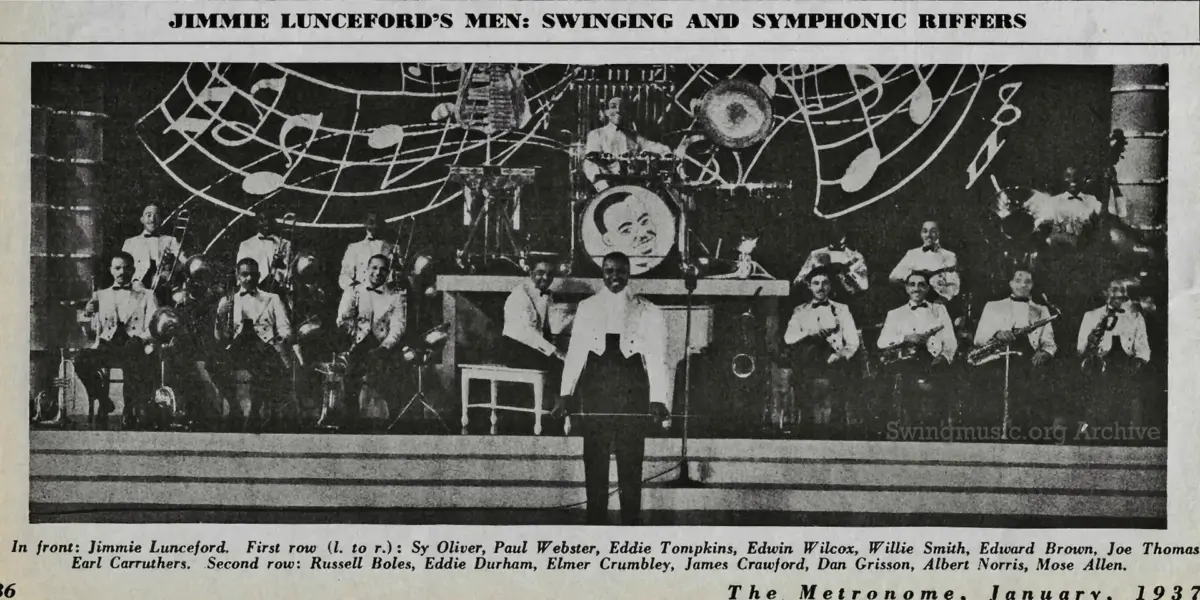
Jimmie Lunceford’s Men: Swinging And Symphonic Riffers
In front: Jimmie Lunceford. First row (l. to r.): Sy Oliver, Paul Webster, Eddie Tompkins, Edwin Wilcox, Willie Smith, Edward Brown, Joe Thomas Earl Carruthers. Second row: Russell Boles, Eddie Durham, Elmer Crumbley, James Crawford, Dan Grisson, Albert Norris, Mose Allen.
The Metronome, January, 1937
More On Jimmie Lunceford And His Swinging Men in 1937:
In June 1937, the Jimmie Lunceford Orchestra was at the peak of its power, widely regarded as the “cleanest” and most disciplined ensemble in jazz. The headline “Swinging and Symphonic Riffers” perfectly captures the duality that made them unique: they combined the raw energy of a riff-based swing band with the intricate, polished orchestration typically reserved for symphonic groups.
The “Lunceford Style” in 1937
While other bands of the era, like Count Basie’s, focused on loose, driving improvisation, Lunceford’s group was built on impeccable ensemble precision.
The Three Ps: Lunceford ran his band with a strict credo of Precision, Punctuality, and Presentation.
The Two-Beat Swing: Unlike the standard four-beat “walking” rhythm of the time, the Lunceford band was famous for a “bouncing” two-beat feel, often called the Lunceford Two-Beat.
Showmanship: They were famous for “Glee Club” vocal harmonies and visual tricks, such as throwing and catching instruments or synchronized horn waving, all while maintaining flawless musical timing.
Key Figures and Milestones
By mid-1937, the band was a juggernaut of both the charts and the ballroom floor.
Sy Oliver’s Influence: As the primary arranger, Sy Oliver was the architect of the band’s sound. His charts, such as the legendary “For Dancers Only” (recorded June 15, 1937), became the gold standard for big band writing.
The Arrival of Trummy Young: Trummy Young joined the band in 1937, bringing a new level of star power as a trombonist and vocalist. His first major hit with the group, “Margie,” would soon become one of their most enduring recordings.
European Tour: During the summer of 1937, the band toured Europe, solidifying their reputation as an international sensation before returning to dominate the American “one-nighter” circuit. The band was so respected during this period that in “Battle of the Bands” competitions, they frequently outperformed the likes of Benny Goodman and Count Basie, winning purely on the strength of their flawless execution and visual flair.
Hear the Lunceford Orchestra on our live radio stream and head back to the main Swing Era Magazine Scan Archive while you listen.