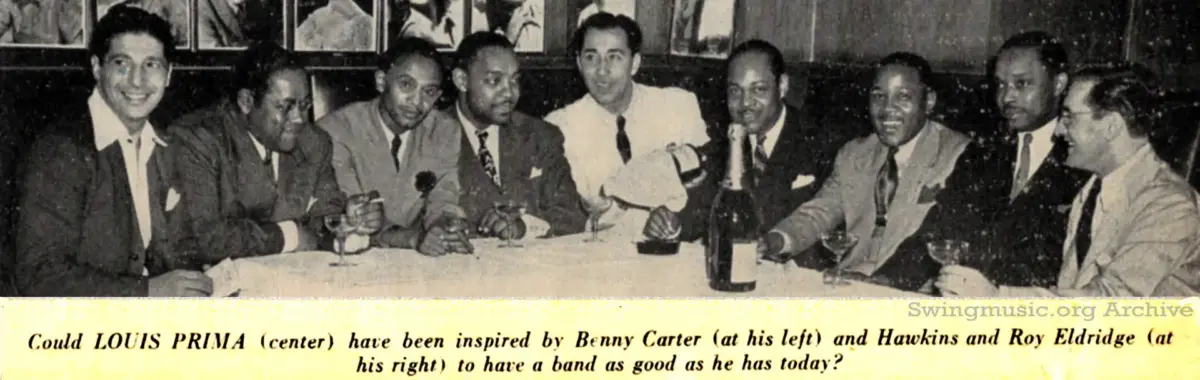
Louis Prima (center) sits with Benny Carter, Coleman Hawkins, and Roy Eldridge in this 1941 DownBeat scan.
The Original Caption: Could LOUIS PRIMA (center) have been inspired by Benny Carter (at his left) and Hawkins and Roy Eldridge (at his right) to have a band as good as he has today?
A 1941 Louis Prima 52nd Street Jazz Summit
This legendary shot from the September 1, 1941, issue of DownBeat captures a literal “Who’s Who” of jazz royalty. These icons gathered together at a single table at Kelly’s Stable in NYC. Specifically, our best estimate of the personnel includes the following:
Starting on the far left, we see a young Sam Butera. He subsequently became Prima’s legendary sax man in Las Vegas. Next is the drumming pioneer Zutty Singleton; notably, his glasses make him look a bit like a young Fats Domino. Then we have the master arranger Benny Carter, with Louis Prima himself holding court in the center.
Furthermore, to Prima’s right sits Coleman Hawkins, the “Father of the Tenor Sax,” followed by Roy Eldridge on trumpet. Next is the powerhouse trumpeter and vocalist Hot Lips Page. Finally, on the far right, is the premier Chicago-style drummer George Wettling. (Fans often mistake him for Tommy Dorsey in this shot).
If you have other info on the personnel in this photo please drop us a line.
Why This Louis Prima Photo Matters
In 1941, this was more than just a social gathering. Instead, it was a major statement for Louis Prima. At the time, he leaned into high-energy showmanship with his Gleeby Rhythm Orchestra. However, sitting with “serious” innovators like Hawkins and Eldridge gave him massive musical street cred.
This image reminded the world that Prima was a peer to the greatest architects of jazz. In fact, he didn’t just write “Sing, Sing, Sing” as a novelty; he was a master musician. Ultimately, this image also stands as a rare document of the racial and stylistic integration that made 52nd Street the beating heart of American music.
Dive Deeper Into 52nd Street History
- Archive: View more rare scans in our Original Magazine Archives.
- Context: Read about the history of 52nd Street Jazz during the 1940s.
- Listen: Tune in to the latest sounds on Swingmusic.org Radio.