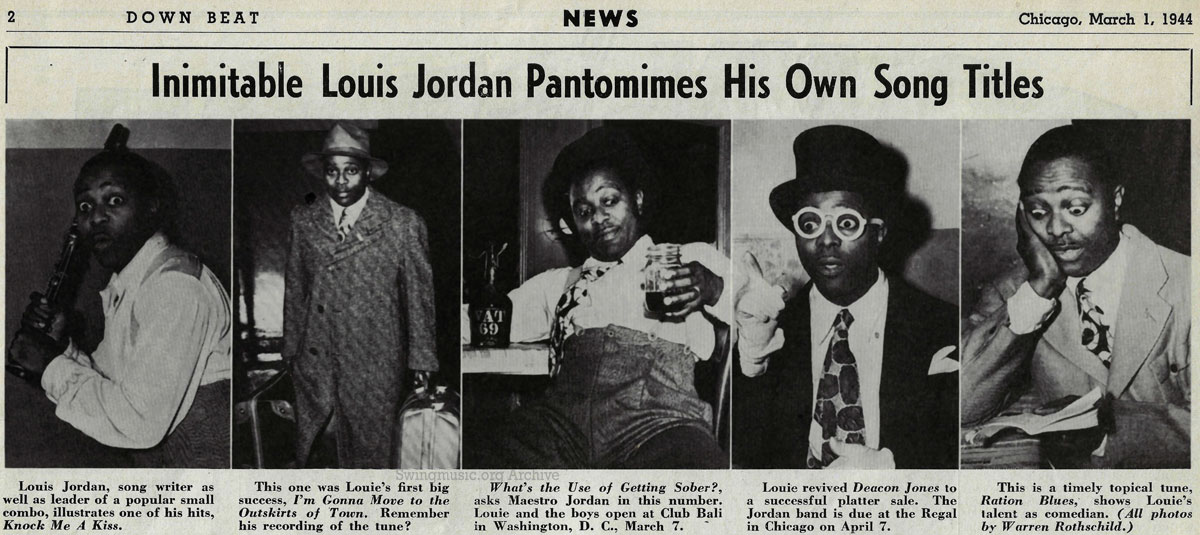
Seen pantomiming some of his hits is “The King Of The Jukebox” in this original Louis Jordan 1944 Downbeat magazine scan.
Louis Jordan 1944 Downbeat Scan Original Text:
Photo 1: Louis Jordan, song writer as well as leader of a popular small combo, illustrates one of his hits, Knock Me A Kiss.
Photo 2: This one was Louie’s first big success, I’m Gonna Move to the Outskirts of Town. Remember his recording of the tune?
Photo 3: What’s the Use of Getting Sober?, asks Maestro Jordan in this number. Louie and the boys open at Club Bali in Washington, D. C., March 7.
Photo 4: Louie revived Deacon Jones to a successful platter sale. The Jordan band is due at the Regal in Chicago on April 7.
Photo 5: This is a timely topical tune, Ration Blues, shows Louie’s talent as comedian. (All photos by Warren Rothschild.)
More On This Louis Jordan 1944 Downbeat Scan
These five photos by Warren Rothschild in the March 1, 1944, Downbeat capture Louis Jordan “pantomiming” his biggest hits. Rather than candid shots from a film set, these were likely an editorial collaboration to capitalize on the Soundie craze. Soundies were 3-minute films played on the Mills Panoram, a “movie jukebox” where a dime bought a 16mm projection. Rothschild’s staged shots brought that visual energy to the page, stimulating interest in Jordan’s “total entertainer” persona.
The 1944 Economy & Chart Facts
At the time of this article, Jordan was bridging the gap between “Race records” and the mainstream. Between his March 7 gig at the Club Bali in D.C. and his April 7 headliner at the Regal Theater in Chicago, he was a massive commercial force. Here is some information on the songs mentioned above:
“Ration Blues”: A direct commentary on WWII scarcity. It hit #1 on the Billboard Harlem Hit Parade in early 1944 and stayed in the Top Ten for 21 weeks. It was a rare triple-threat crossover, reaching #11 on the Pop chart and #1 on the Folk (Country) chart (Billboard, 1944).
“What’s the Use of Getting Sober”: His first #1 hit (December 1942).
“I’m Gonna Move to the Outskirts of Town”: A #2 hit (1942) that proved small “jump” groups could outsell some 16-piece big bands.
“Knock Me a Kiss” & “Deacon Jones”: Massive jukebox staples that solidified his “King of the Jukebox” title.
The Regal Theater Gig (mentioned above): Opening on April 7, Jordan played to a 3,000-seat house. By this tour, he was commanding $2,000 per night, up from $350 the previous year.
The Lineage: From Jordan to Brown and Ali
Jordan provided the blueprint for the next generation of icons:
James Brown: In his 1986 autobiography, James Brown: The Godfather of Soul (with Bruce Tucker), Brown stated: “Jordan influenced me in every way. He could sing, he could dance, he could play, he could act. He could do it all.” Brown famously saw Jordan in the film Caldonia as a teenager in 1946 and decided right then to become an entertainer.
Muhammad Ali: The University of Louisville’s Muhammad Ali Archive (The Artist Research Guide) identifies Ali as a master storyteller belonging to the same oral tradition as Louis Jordan and James Brown, using rhythmic wit as a tool of psychological dominance. Jordan’s rapid-fire, syncopated delivery and “rhymed boasting” (heard on tracks like “Saturday Night Fish Fry” and “Beware”) provided the cadence Ali used for his pre-fight poems.
Perspective:
When Jordan left D.C. for Chicago in the spring of 1944, he wasn’t just playing “funny songs.” He was perfecting the “total entertainer” persona that would eventually give us the Godfather of Soul and the Greatest of All Time.
References:
Photographer: Warren Rothschild, Downbeat Magazine, March 1, 1944.
James Brown: The Godfather of Soul, James Brown with Bruce Tucker, 1986.
Muhammad Ali Link: The Artist Research Guide, University of Louisville Muhammad Ali Archives.
Charts: Billboard Magazine Archive, Feb-April 1944.
Soundie Tech: Soundies: A History of the Musical Jukebox Films of the 1940s, Mark Cantor
Hear Louis Jordan on our big band and Swing Era radio stream. Explore more historic jazz scans in our Swing Era Magazine Scan Archive.