 Skip to content
Charlie Christian: A Legacy in Jazz Guitar
Charlie Christian was the father of the electric jazz guitar. He played with Benny Goodman and changed swing music forever. This page features his original 1942 obituary from Metronome Magazine. We provide this transcript to honor his career. Read the full historical text below to understand his impact on jazz history.
At a Glance: Charlie Christian’s Career
- Innovation: Christian turned the guitar into a lead instrument.
- Impact: He joined the Benny Goodman Sextet in 1939.
- Legacy: His style bridged the gap between Swing and Bebop.
- Gear: He famously played the Gibson ES-150 electric guitar.
- History: This 1942 obituary marks the end of an era.
Charlie Christian Obituary Original Text:
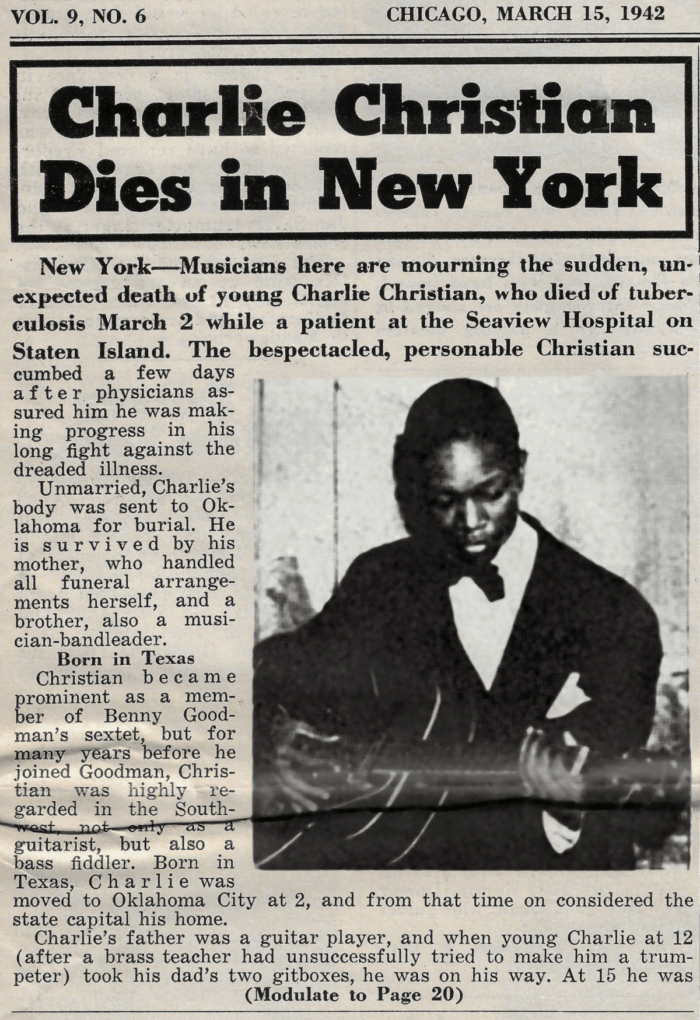
New York – Musicians here are mourning the sudden, unexpected death of young Charlie Christian, who died of tuberculosis March 2 while a patient at the Seaview Hospital on Staten Island. The bespectacled, personable Christian succumbed a few days after physicians assured him he was making progress in his long fight against the dreaded illness.
Unmarried, Charlie’s body was sent to Oklahoma for burial. He is survived by his mother, who handled all funeral arrangements herself, and a brother, also a musician-bandleader.
Born in Texas Christian became prominent as a member of Benny Good-man’s sextet, but for many years before he joined Goodman, Christian was highly regarded in the Southwest, not only guitarist, but_also bass fiddler. Born in as a a Texas, Charlie was moved to Oklahoma City at 2, and from that time on considered the state capital his home.
Charlie’s father was a guitar player, and when young Charlie at 12 (after a brass teacher had unsuccessfully tried to make him a trumpeter) took his dad’s two gitboxes, he was on his way. At 15 he was
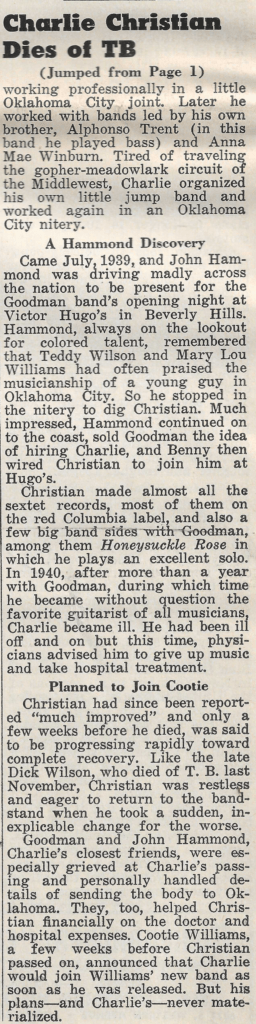
working professionally in a little Oklahoma City joint. Later he worked with bands led by his own brother, Alphonso Trent (in this band he played bass) and Anna Mae Winburn. Tired of traveling the gopher-meadowlark circuit of the Middlewest, Charlie organized his own little jump band and worked again in an Oklahoma City nitery.
A Hammond Discovery
Came July, 1939, and John Hammond was driving madly across the nation to be present for the Goodman band’s opening night at Victor Hugo’s in Beverly Hills. Hammond, always on the lookout for colored talent, remembered that Teddy Wilson and Mary Lou Williams had often praised the musicianship of a young guy in Oklahoma City. So he stopped in the nitery to to dig dig Christian. Much impressed, Hammond continued on to the coast, sold Goodman the idea of hiring Charlie, and Benny then wired Christian to join him at Hugo’s.
Christian made almost all the sextet records, most of them on the red Columbia label, and also a few big band sides with Goodman, among them Honeysuckle Rose in which he plays an excellent solo. In 1940, after more than a year with Goodman, during which time he became without question the favorite guitarist of all musicians, Charlie became ill. He had been ill off and on but this time, physicians advised him to give up music and take hospital treatment.
Planned to Join Cootie
Christian had since been report-ed “much improved” and only a few weeks before he died, was said to be progressing rapidly toward complete recovery. Like the late Dick Wilson, who died of T. B. last November, Christian was restless and eager to return to the band-stand when he took a sudden, in-explicable change for the worse.
Goodman and John Hammond, Charlie’s closest friends, were especially grieved at Charlie’s passing and personally handled de-tails of sending the body to Oklahoma. They, too, helped Christian financially on the doctor and hospital expenses. Cootie Williams, few weeks before Christian a passed on, announced that Charlie would join Williams’ new band as soon as he was released. But his plans-and Charlie’s never materialized.
Summary: The Legacy of a Jazz Giant
Charlie Christian changed music forever in a very short time. He moved the guitar from the background to the front of the band. His work with Benny Goodman defined the electric sound of the Swing Era. Although his life ended at age 25, his genius lived on. Modern jazz guitar starts with the recordings Christian made between 1939 and 1941. We preserve this Metronome obituary to honor his massive impact on American music.
Hear Charlie Christian’s fine guitar work on the Swingmusic.org Big Band & Jazz Radio Stream. Explore more rare jazz scans in our main Swing Era Magazine Scan Archive while you listen.
