 Skip to content
Duke Ellington: 1937 Cotton Club Parade
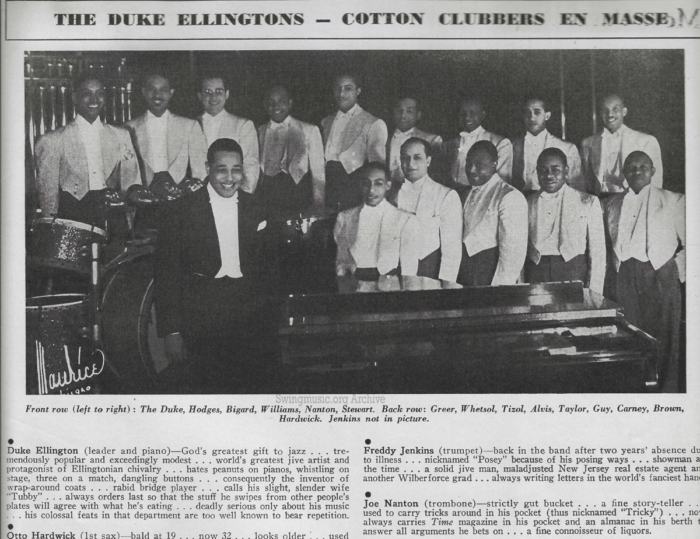
This scan from the April 1937 Metronome captures the Duke Ellington Orchestra. When this publication hit the stands, the band was one month in to its historic residency at the Midtown Cotton Club (200 W. 48th St). This engagement was part of the “Second Edition” of the downtown Cotton Club Parade revue. It was a massive production that ran from March through June 1937.
Duke Ellington Cotton Clubbers Scan Text
Front row (left to right): The Duke, Hodges, Bigard, Williams, Nanton, Stewart. Back row: Greer, Whetsol, Tizol, Alvis, Taylor, Guy, Carney, Brown, Hardwick. Jenkins not in picture.
- Duke Ellington (leader and piano)—Celebrated as a modest genius and the top “jive artist,” he is described as a rabid bridge player who dislikes on-stage whistling and loves stealing food from his bandmates’ plates.
- Otto Hardwick (1st sax)—Bald since age 19, now 32.
- Freddy Jenkins (trumpet)—Rejoined the band after illness; nicknamed “Posey,” he is noted for his showmanship and fancy handwriting.
- Joe Nanton (trombone)—strictly gut bucket a fine story-teller used to carry tricks around in his pocket (thus nicknamed “Tricky”). Always carries Time magazine in his pocket and an almanac in his berth to answer all arguments he bets on… a fine connoisseur of liquors.
(Note: The original Metronome article contained more detailed biographies for other members of Duke Ellington’s 1937 Cotton Clubbers. Due to size constraints, these were not included in our scan. We include them below.)
- Otto Hardwick (1st sax) (continued from above)—bald at 19 now 32… another Washingtonian… Duke gave him his first sax… lived in Europe for two years… looks older than he really is.
- Barney Bigard (Clarinet/Sax)—The Creole with the woodwind… loves Creole cooking… always complaining about the cold… one of the few who can actually read the Duke’s mind on stage.
- Johnny Hodges (Alto Sax)—The Rabbit… looks like he’s sleeping while he plays the most beautiful alto in the world… rarely speaks, just plays… obsessed with his vegetable garden when off the road.
- Harry Carney (Baritone Sax)—The anchor… has been with Duke since he was a kid… drives the band bus… never misses a note or a meal.
- Sonny Greer (Drums)—The man with the high hat and the bells… the world’s most elegant drummer… loves flashy clothes almost as much as the Duke… his drum kit is a city of brass.
- Lawrence Brown (Trombone)—The high-note specialist… very formal… doesn’t drink or smoke… known as ‘The Deacon’ because of his straight-laced ways.
- Rex Stewart (Cornet)—The man with the half-valve… a collector of fine watches… always tinkering with his horn to find that new sound.
- Cootie Williams (Trumpet)—The master of the plunger and the growl… quiet and serious until he picks up the horn… a specialist in the “jungle” sounds that made the band famous.
- Arthur Whetsol (Trumpet)—The lyrical one… has a soft, sweet tone… another longtime member who knows the Duke’s music inside and out.
- Juan Tizol (Valve Trombone)—The Puerto Rican influence… writes many of the band’s exotic themes like “Caravan”… a disciplined musician and a master of the valve trombone.
- Fred Guy (Guitar)—The rhythm’s steady pulse… switched from banjo to guitar years ago… another loyal veteran of the Ellington organization.
- Hayes Alvis (Bass)—One half of the double-bass powerhouse… strong and steady… keeps the foundation solid.
- Billy Taylor (Bass)—The other half of the bass team… works in perfect tandem with Alvis to give the band that heavy, driving swing.
More On The Cotton Club Parade
The Cotton Club Parade featured a book by Irving Mills and music/lyrics by Ellington himself. The downtown club maintained a strict segregation policy. During this period the Ellington Orchestra often appeared in elegant white mess jackets and crimson trousers. The aggregation performed two nightly floor-shows that were broadcast live across the nation.
The Departure of Freddie Jenkins
A notable detail of this 1937 lineup is the absence of trumpeter Freddie Jenkins. Jenkins struggled with a lung ailment. However, Jenkins made a brief “comeback” just months earlier on the March 1937 recording of “I’ve Got to Be a Rug Cutter.” Unfortunately, the comeback was short-lived. Consequently, he was replaced by the brilliant cornetist Rex Stewart. Jenkins retired from the “hot chair” permanently at age 32. Even so, he remained a beloved figure in the jazz world for decades as a songwriter and press agent.
The Sound of a Musical Transition
The year 1937 was a pivotal “bridge” for the Duke Ellington Orchestra. The band was actively moving away from the theatrical “Jungle Style” that defined their early years toward a more sophisticated, orchestral sound.
Just days after this magazine hit stands, the band was in the studio recording atmospheric tracks like “Azure.” Indeed, this shows that Ellington was moving toward “high art” long before the famous 1940 Blanton-Webster era began.
References & Historical Sources
- Original Publication: Metronome Magazine, April 1937. “The Duke Ellingtons-Cotton Clubbers En Masse”.
- Show Records: Cotton Club Parade [program.] Second Edition, March–June 1937.
- Discography: Duke Ellington at the Cotton Club 1937-30. Jazz Messengers Records.
Hear the Duke Ellington Orchestra in all its glory on the Swingmusic.org Big Band & Jazz Radio Stream. Explore more historic jazz scans in our Swing Era Magazine Scan Archive.
