 Skip to content
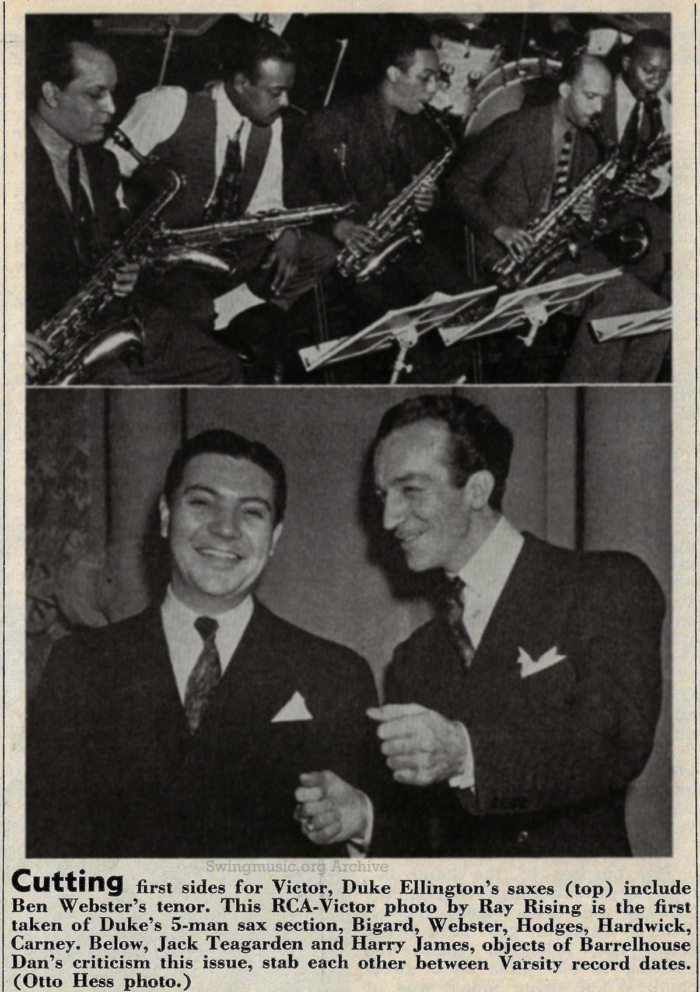
This Duke Ellington, Harry James and Jack Teagarden scan comes from the April 1, 1940, DownBeat magazine. It captures a defining moment for the Ellington big band as they transition to the RCA-Victor label and establish their legendary new sound.
Duke Ellington / James / Teagarden Scan Text:
“Cutting first sides for victor, Duke Ellington’s saxes (top) include Ben Webster’s tenor. This RCA-Victor photo by Ray Rising is the first taken of Duke’s five-man sax section, Bigard, Webster, Hodges, Hardwick, Carney. Below, Jack Teagarden and Harry James, objects of Barrelhouse Dan’s criticism this issue, stab each other during Varsity record dates. (Otto Hess photo).”
Duke Ellington: Blanton-Webster Era Birth
This April 1, 1940, issue of DownBeat (Volume 7, Issue 7) captures the Duke Ellington Orchestra at a key time in jazz history. Known as the “Blanton-Webster” era, this Ellington Orchestra lineup was defined by the addition of bassist Jimmie Blanton in 1939 and tenor saxophonist Ben Webster in early 1940. This specific five-man reed section—Barney Bigard, Ben Webster, Johnny Hodges, Otto Hardwick, and Harry Carney—established the modern “Ellington sound” during their transition to the Victor label. This photo is significant because it is the first publicly released photo ever documenting this new sax section.
By the date of this original Dowbeat publication, the section had already recorded some of Ellington’s most monumental tracks:
- “Jack the Bear” (March 6, 1940): Showcasing Blanton’s revolutionary bass work.
- “Ko-Ko” (March 6, 1940) and “Conga Brava” (March 15, 1940).
- “Cotton Tail”: Recorded shortly after in May 1940, this track features a legendary Ben Webster solo and a complex five-part saxophone soli that remains a benchmark for jazz musicians today.
Harry James and Jack Teagarden On Varsity
The bottom photo shows star attractions Harry James and Jack Teagarden sharing a joke at the Varsity studios. The mention of them “stabbing each other” refers to the friends cracking each other up between takes. At the time of this Downbeat publication in April 1940, both leaders were recording heavily for Eli Oberstein’s Varsity label.
The Harry James Orchestra recorded:
- “Tuxedo Junction“ and “Alice Blue Gown“ (Feb 12, 1940)
- “How High the Moon“ and “Carnival of Venice“ (March 18, 1940)
The Jack Teagarden Orchestra recorded:
- “The Blues“ and “If I Could Be With You“ (Feb 1940)
- “My Melancholy Baby“ and “Can’t We Talk It Over?“
References & Historical Sources
- Original Publication: DownBeat Magazine, Vol. 7, Issue 7, April 1, 1940.
- Discography: The Blanton–Webster Band (Victor/Bluebird Records, 1940).
- Historical Context: Varsity Records recording logs and the “Barrelhouse Dan” columns of 1940.
Hear the Duke Ellington Orchestra, Harry James and Jack Teagarden on the Swingmusic.org Big Band & Jazz Radio Stream. Explore more historic jazz scans in our Swing Era Magazine Scan Archive.
