 Skip to content
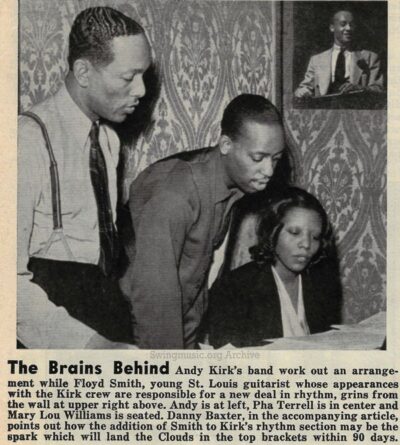
Mary Lou Williams was the true musical mastermind guiding the rhythm, identity, and arrangements that propelled Andy Kirk’s Clouds of Joy into national stardom. While historic jazz headlines from the era frequently focused on frontline male bandleaders and technical horn soloists, the foundational architecture of the Kansas City Swing sound was quietly being constructed from behind her piano keys. This rare June 1939 Down Beat magazine scan captures a snapshot of her career during a demanding period of relentless touring. Although the sensational column headline explicitly shifts focus to the temporary addition of guitarist Floyd Smith as the band’s “new spark,” the accompanying archival photograph and text verify that Mary Lou Williams remained the most critical cog in the Andy Kirk big band.
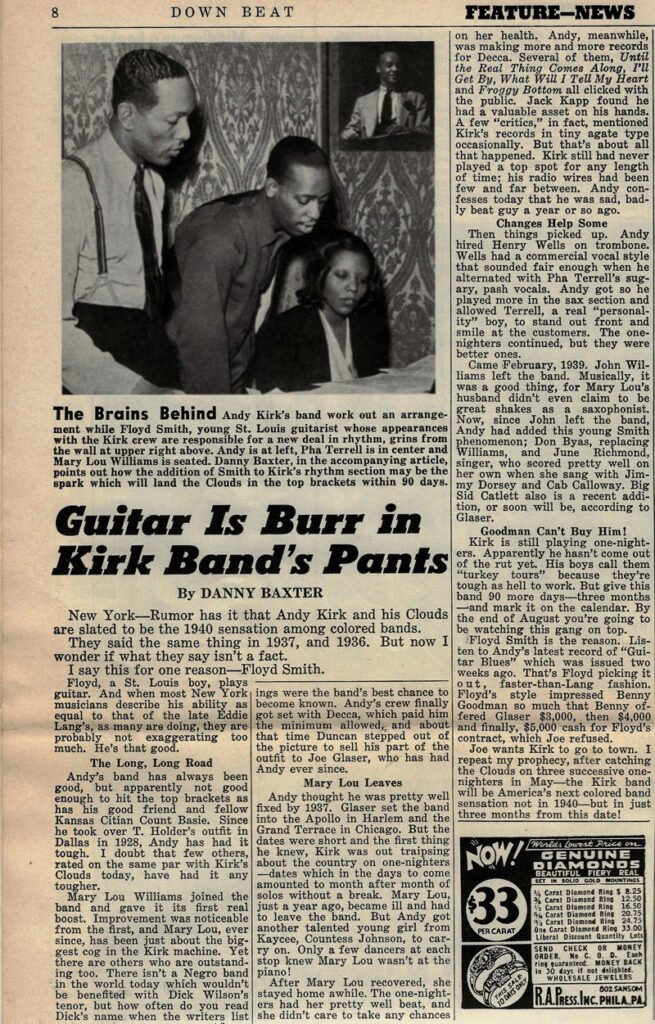
Archival Transcription:
Guitar Is Burr in Kirk Band’s Pants
The Brains Behind: Andy Kirk’s band work out an arrangement while Floyd Smith, young St. Louis guitarist whose appearances with the Kirk crew are responsible for a new deal in rhythm, grins from the wall at upper right above. Andy is at left, Pha Terrell is in center and Mary Lou Williams is seated. Danny Baxter, in the accompanying article, points out how the addition of Smith to Kirk’s rhythm section may be the spark which will land the Clouds in the top brackets within 90 days.
By DANNY BAXTER
New York—Rumor has it that Andy Kirk and his Clouds are slated to be the 1940 sensation among colored bands.
They said the same thing in 1937, and 1936. But now I wonder if what they say isn’t a fact.
I say this for one reason—Floyd Smith.
Floyd, a St. Louis boy, plays guitar. And when most New York musicians describe his ability as equal to that of the late Eddie Lang’s, as many are doing, they are probably not exaggerating too much. He’s that good.
The Long, Long Road
Andy’s band has always been good, but apparently not good enough to hit the top brackets as has his good friend and fellow Kansas Citian Count Basie. Since he took over T. Holder’s outfit in Dallas in 1929, Andy has had it tough. I doubt that few others, rated on the same par with Kirk’s Clouds today, have had it any tougher.
Mary Lou Williams joined the band and gave it its first real boost. Improvement was noticeable from the first, and Mary Lou Williams, ever since, has been just about the biggest cog in the Kirk machine. Yet there are others who are outstanding too. There isn’t a Negro band in the world today which wouldn’t be benefited with Dick Wilson’s tenor, but how often do you read Dick’s name when the writers list the greats of that instrument?
Youngster Gave Him Boost
Andy was first managed by the Southwest Amusement Co., operators of ballrooms in Tulsa and Oklahoma City. The arrangement was not satisfactory. Harold Duncan, a young man in Kansas City who, with his father W. H. Duncan, gave the Clouds many seasons of work at Kansas City’s Fairyland Park, was Andy’s next manager. Harold proved a good man for Andy to have as a guide, but financial returns for some time were less than slim bucks in the sticks of western Missouri.
So young Duncan took the band to New York. He didn’t make it overnight, but before long Joe Glaser, who manages Louis Armstrong, decided that Andy Kirk had a valuable asset on his hands. A few “critics,” in fact, labeled them “the loop-the-loop band,” playing occasionally. But that’s about all that happened. Kirk still had never played a top spot for any length of time; his radio wires had been few and far between. Andy confesses today that he was sad, badly beat guy a year or so ago.
Changes Help Some
Then things picked up. Andy hired Henry Wells on trombone. Wells had a conducting style—one that sounded fair enough when he alternated with Pha Terrell’s sugary, high vocals. Andy got so he played more in the sax section and allowed Terrell, a real “personality” boy, to stand out front and smile at the costumers. The one-nighters continued, but they were better ones.
Came February, 1939. John Williams left the band. Musically, it was a good thing, for Mary Lou’s husband didn’t even claim to be great shakes as a saxophonist. Now, since John left the band, Andy has added this young Smith phenomenon; Don Byas, replacing Williams, and June Richmond, singer, who scored pretty well on her own when she sang with Jimmy Dorsey and Cab Calloway. Big Sid Catlett also is a recent addition, or soon will be, according to Glaser.
Goodman Can’t Buy Him!
Kirk is still playing one-nighters. Apparently he hasn’t come out of the rut yet. His boys call them “turkey tours” because they’re tough as hell to work. But give this band 90 more days—three months—and mark it on the calendar. By the end of August you’re going to be watching this gang on top.
Floyd Smith is the reason. Listen to Andy’s latest record of “Guitar Blues” which was issued two weeks ago. That’s Floyd picking it out, faster-than-Lang fashion. Floyd’s style impressed Benny Goodman so much that Benny offered Glaser $3,000, then $4,000 and finally, $5,000 cash for Floyd’s contract, which Joe refused.
Joe wants Kirk to go to town. I repeat my prophecy, after catching the Clouds on three successive one-nighters in May—the Kirk band will be America’s next colored band sensation not in 1940—but in just three months from this date!
Mary Lou Leaves
Andy thought he was pretty well fixed by 1937. Glaser set the band into the Apollo in Harlem and the Grand Terrace in Chicago. But the dates were short and the first thing he knew, Kirk was out traipsing about the country on one-nighters—dates which in the days to come amounted to month after month of solos without a break. Mary Lou, just a year ago, became ill and had to leave the band. But Andy got another talented young girl from Kansas, Countess Johnson, to carry on. Only a few dancers at each stop knew Mary Lou Williams wasn’t at the piano!
After Mary Lou recovered, she stayed home awhile. The one-nighters had her pretty well beat, and she didn’t care to take any chances ings were the band’s best chance to become known. Andy’s crew finally got set with Decca, which paid him the minimum allowed, and about that time Duncan stepped out of the picture to sell his part of the outfit to Joe Glaser, who has had Andy ever since.
The Enduring Legacy of Mary Lou Williams
While this 1939 snapshot catches her in the midst of the grueling swing band circuit schedule, the full spectrum of her immense contributions to American music stretched far beyond the Clouds of Joy. Mary Lou Williams wasn’t just a phenomenal swing pianist; she was a foundational structural architect of jazz history across multiple generations.
Freelance Masterpieces for Swing Era Titans
- The Master Arranger: She broke major gender barriers in a male-dominated industry by writing powerhouse charts. Beyond Andy Kirk’s band, Mary Lou Williams sold classic, high-demand arrangements to jazz titans like Benny Goodman (the smash-hits “Roll ‘Em” and “Camel Hop”), Duke Ellington (providing over 40 arrangements over the decades, including the blistering “Blue Skies” which became “Trumpets No End”), Jimmie Lunceford (“What’s Your Story, Morning Glory?”), and custom rhythm charts for Louis Armstrong and Earl Hines.
Mentoring Bebop and Pioneering Sacred Jazz
- The Bebop Mentor: When the big band swing era began to fade in the 1940s, her Harlem apartment became an iconic laboratory for modern jazz. Mary Lou Williams directly mentored and shaped the harmonic ideas of bebop innovators like Thelonious Monk, Bud Powell, and Dizzy Gillespie, ensuring her swing-era sensibilities bridged perfectly into the modern jazz underground.
- Orchestral & Sacred Jazz Pioneer: She continually pushed past traditional big band limitations, composing the groundbreaking Zodiac Suite for chamber ensembles and symphony orchestras. In her later decades, her deep spiritual journey led her to create massive religious choral jazz works, culminating in Mary Lou’s Mass, which made history when performed live inside St. Patrick’s Cathedral.
Archival clippings like this June 1939 feature remind us that Mary Lou Williams was a rare, absolute continuum in jazz history. She drafted flash-lit swing arrangements in the back of moving cars. Later, she reshaped modern bebop harmony and pioneered symphonic sacred jazz. Her brilliant mind constantly redefined the boundaries of American orchestration for over fifty years.
Hear Mary Lou Williams with Andy Kirk’s 12 Clouds Of Joy and her arrangements for Andy Kirk, Benny Goodman, Jimmie Lunceford and Duke Ellington on the Swingmusic.org Big Band & Jazz Radio Stream. Explore more historic jazz scans in our Swing Era Magazine Scan Archive.
